Skip to content
abdullah.

Service / Business Automation & Internal Tools

Business Process Automation Services with visible control.

Make recurring work easier to run, inspect, and recover without hiding approvals, exceptions, or operational ownership.

Engagement fit

Best fit for

  • Recurring approval, review, triage, and handoff work
  • Operations held together by messages and spreadsheets
  • High-accountability workflows that need an evidence trail
01Before / after

From chasing messages to one visible workflow

Before

Held together by messages

  1. Request arrivesIn an inbox, a chat thread, or a form nobody watches.
  2. Someone copies itInto a spreadsheet, with typos and missing fields.
  3. Chasing approvalReminders by message; the decision is not recorded.
  4. Status unknown“Where is this?” is answered by asking around.

After

One inspectable workflow

  1. Structured triggerForm, event, or API creates a validated item.
  2. Automatic routingRules assign owners and fetch the context they need.
  3. Approval with contextThe reviewer sees evidence, then approves or overrides.
  4. Visible statusEvery item has an owner, a state, and a history.
02Control flow

Automation with visible human control

Control flow
  1. 01TriggerEvent, form, schedule, API
  2. 02RulesValidation and routing✕ unclear: to 05 Exception queue
  3. 03Automated stepsLookups, updates, notifications→ needs approval: to 06 Human decision⇢ routine, low-risk: to 04 Record
  4. 04RecordOutcome, evidence, next action
  5. 05Exception queueAnything the rules cannot place✕ assigned: to 06 Human decision
  6. Human control06Human decisionReview, approve, override◆ approved: to 04 Record
  7. 07Activity trailWho decided what, and why
  • Automated path
  • Human decision
  • Exception path
  • No approval needed

Repetitive steps can move automatically while approvals and exceptions remain explicit.

03Suitability

What to automate first

Frequency and rule clarity make a task a good candidate; the cost of a wrong step decides how much a person stays involved.

TaskFrequencyRule clarityCost of a wrong stepStart with
Routing incoming requestshighhighlowFull automation with an exception queue
Data sync between toolshighhighmediumAutomation with reconciliation and alerts
Approvals and sign-offmediummediumhighAutomate the preparation; keep the decision human
Triage of ambiguous casesmediumlowmediumSuggested routing with human confirmation
Rare, high-stakes exceptionslowlowhighA clear manual procedure — not automation

Qualitative starting points, confirmed against the real workflow and its exceptions.

04Capabilities

What can be built

  1. 01

    Internal tools for tracking, triage, approvals, and handoffs

  2. 02

    Workflow automation around APIs, forms, and GitHub

  3. 03

    Operational dashboards with useful decision context

  4. 04

    Verification and review flows for high-accountability work

05Delivery

From scope to a working release

  1. 01Observe

    Observe the current workflow and exception paths

  2. 02Automate

    Automate the repetitive steps while preserving human decisions

  3. 03Measure

    Measure time saved and improve the points of real friction

What you should have at handoff

  • Less repetitive work and fewer missed handoffs
  • One inspectable operating workflow
  • Controls and records appropriate to the decision
06Proof

Relevant work

Public builds with live products and source you can inspect. No private client metrics are claimed.

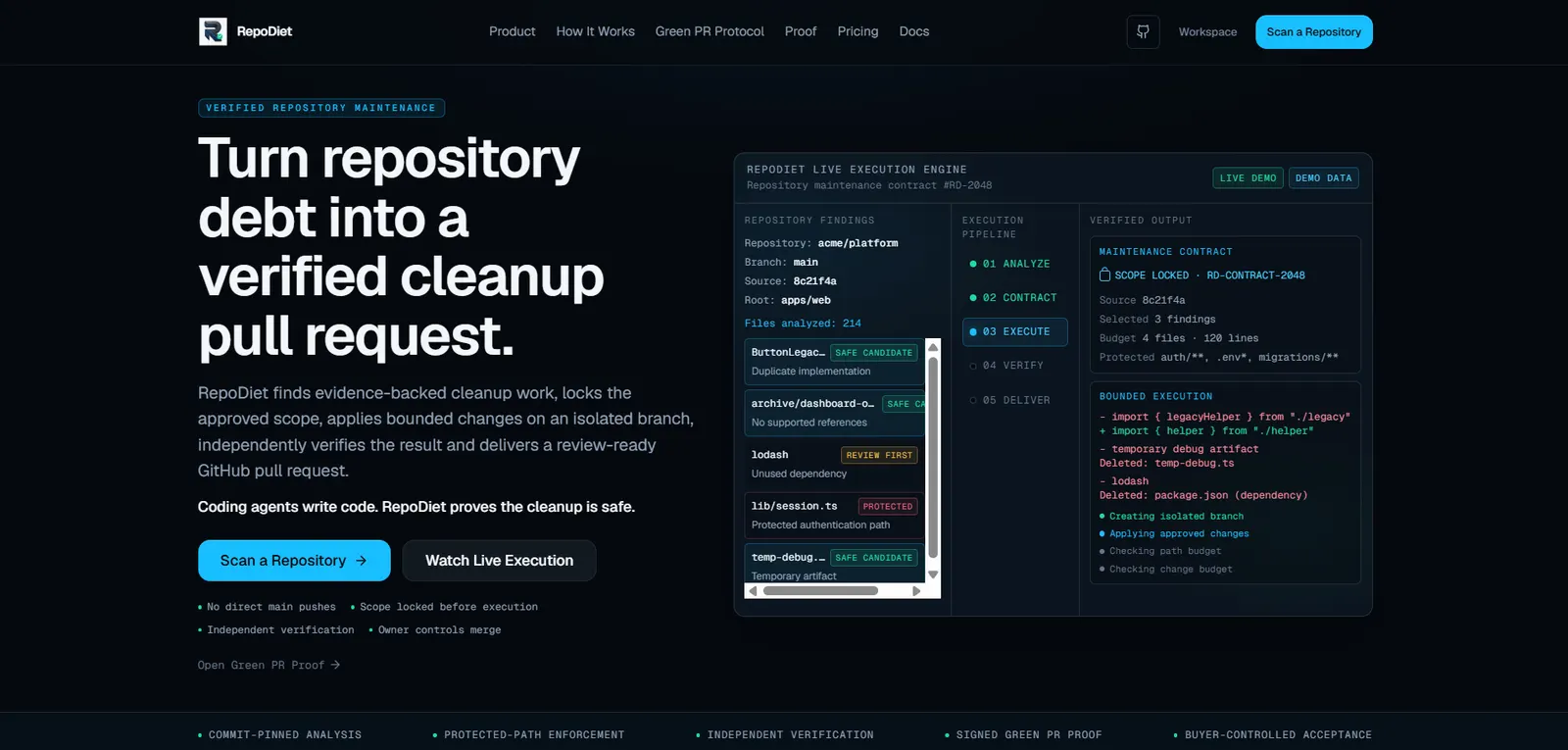
RepoDiet repository maintenance and verification interface

Contract-bound repository maintenance

RepoDiet

Repository maintenance for JS/TS codebases: evidence-gated triage, a signed change contract, bounded changes on an isolated branch, and a signed verification receipt.

Why it is relevantGitHub automation where scoped changes pass a separate verifier role, with its own signing key, before a reviewer sees them.

  • Evidence-gated triage (Knip, jscpd, Madge)
  • Signed, commit-pinned change contracts
  • Separate verifier role and signing key
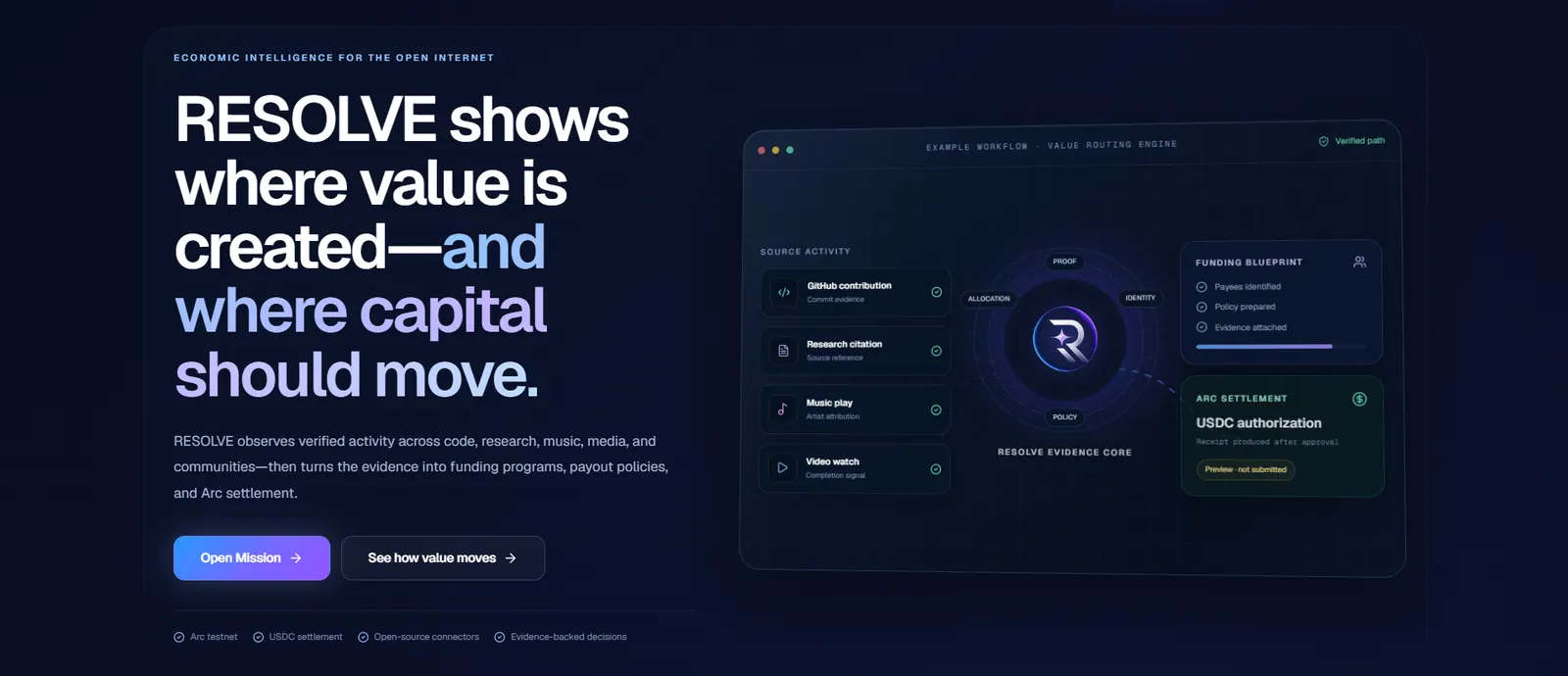
RESOLVE contribution evidence and funding workflow interface

Evidence-backed contribution funding

RESOLVE

A contribution-funding platform that turns verified evidence into policy-checked allocations, with USDC escrow settlement on Arc Testnet.

Why it is relevantVerification and funding decisions stay reviewable instead of disappearing into automation.

  • Evidence connectors and identity resolution
  • Versioned policy snapshots with lineage hashes
  • Quadratic funding in bigint micro-USDC
07Stack

Technical approach

Triggers
  • Forms
  • Webhooks
  • Schedules
  • GitHub events

Work starts from a structured, validated input.

Workflow
  • TypeScript
  • Postgres state
  • Queues

Each item has an owner, a state, and a history.

People
  • Approval views
  • Notifications

Decisions happen with context and are recorded.

Visibility
  • Activity log
  • Operational dashboard

Anyone can answer “where is this?” without asking around.

Projects commonly use TypeScript, Next.js, React, SQL-backed models, Supabase, Postgres, Prisma, REST APIs, webhooks, GitHub, and Vercel. The stack follows the workflow, security boundary, and maintenance need—not a generic checklist.

Remote delivery is structured for clients in the United States, United Kingdom, Canada, and other international markets: written scope, asynchronous progress, scheduled overlap, repository ownership, acceptance criteria, and a deployment handoff are made explicit.
08Questions

Questions about business automation and internal tools

What should be automated first?

Start with a repeatable workflow that has clear inputs, decisions, exceptions, and an observable result. Preserve human judgment where the decision is high risk or ambiguous.

Can you replace a spreadsheet workflow?

Yes, when the spreadsheet is carrying shared state, approvals, reminders, or reporting that would benefit from roles, validation, and a clearer audit trail.

Will people still be able to review decisions?

Yes. Approval points, evidence, overrides, and activity records can remain visible instead of hiding the process behind a black box.

Can the tool connect to our current software?

Usually, if the existing tools expose appropriate APIs, webhooks, exports, or other supported interfaces.

PROJECT INQUIRY

Discuss the workflow you want to automate.

Share the goal, current state, constraints, and useful links. I’ll help identify the most useful path forward.