Case study / Cross-chain USDC portfolio workspace (testnet)
Agora Forge.
A multichain portfolio and execution workspace: aggregated balances, deterministic rebalance logic, and wallet-approved USDC moves via Circle CCTP and LI.FI on testnets.
- Role
- Full-stack engineer
- Type
- Cross-chain portfolio workspace
- Rails
- Circle CCTP via App Kit · LI.FI
- Network
- Arc Testnet + 4 Sepolia testnets
- Origin
- Agora Agent Hackathon
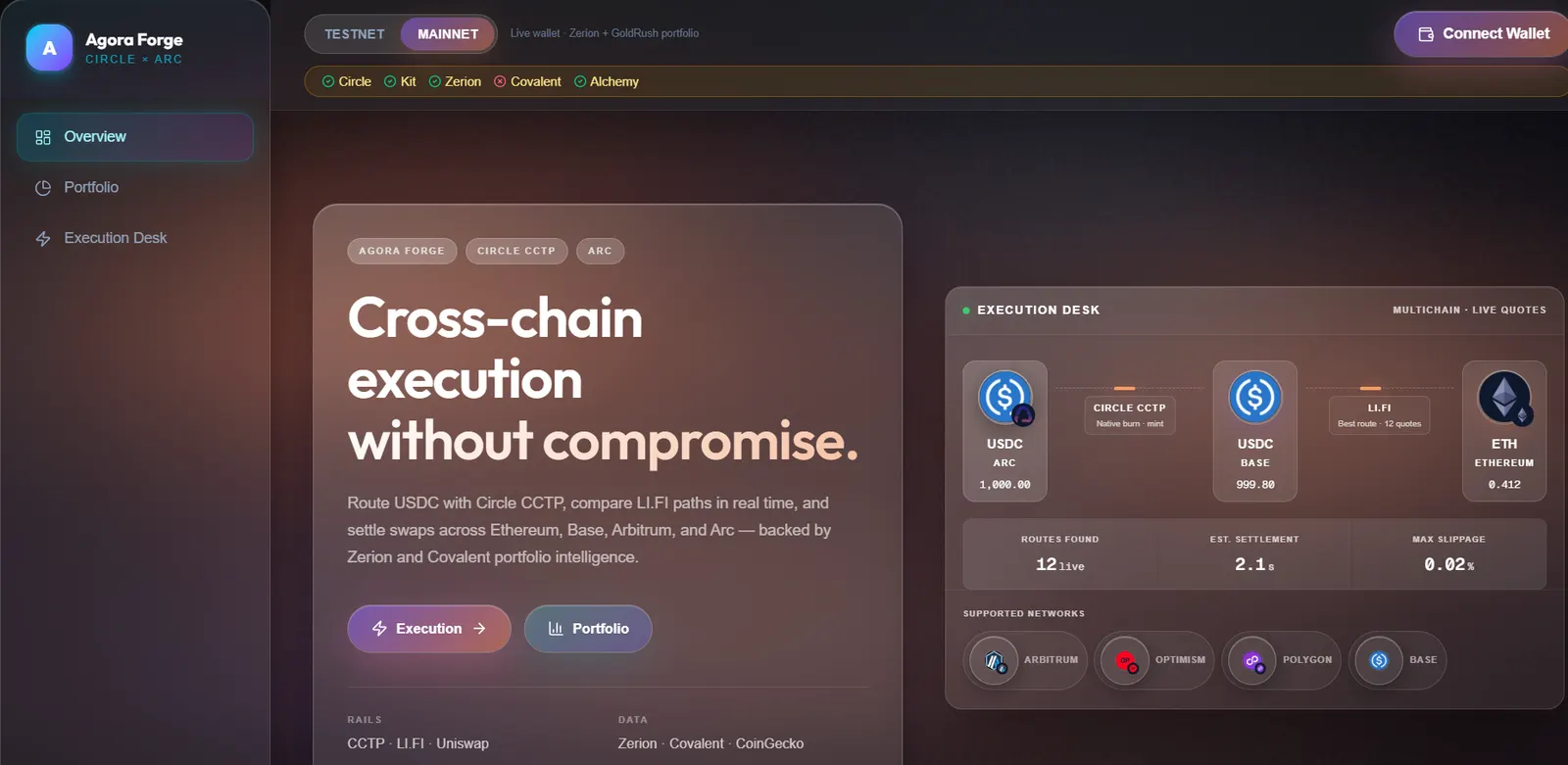
Product interface from the working public build.
- 1Provider status in view
Each data and routing provider shows whether it is connected before a user acts.
- 2Separate surfaces
Overview, portfolio, and execution desk are distinct places with distinct jobs.
- 3Route made legible
The execution desk shows each hop — a CCTP burn, then a LI.FI route — instead of one opaque swap.
- 4Quotes before commitment
Route, settlement, and slippage details appear before anything is signed.
Problem and constraints
Agora Forge was built for the Agora Agent Hackathon (Canteen × Circle × Arc). It explores how a user can move from portfolio context to explicit, wallet-approved cross-chain USDC transactions.
The product needed to make a technically dense workflow understandable without hiding the states a user must evaluate. The public build and source repository are linked above; no private client metrics are claimed.
Role and scope
Muhammad Abdullah worked on Agora Forge as a full-stack engineer. Origin: Agora Agent Hackathon — Canteen × Circle × Arc.
- ProductPortfolio-to-execution workflow
- InterfacePortfolio, execute, and agent-console pages
- EngineeringCCTP and LI.FI execution components
- ReleaseDeployed public testnet build
What was built
Portfolio data is aggregated across chains with Zerion as the primary source and supplementary providers, plus Arc Testnet USDC balance reads. Deterministic allocation and regime logic compiles rebalance jobs. Execution uses Circle CCTP via Circle App Kit (testnet) — the user approves the USDC approve and burn, and Circle handles attestation and mint — alongside LI.FI route comparison and quote-to-transaction execution, App Kit swaps with a Uniswap V3 fallback, a testnet faucet flow, and a multi-chain transaction scanner. The agent console is rule-based automation; every transaction is approved in the user's wallet.
- Multichain portfolio aggregation
- Circle CCTP via App Kit (testnet)
- LI.FI route comparison
- Rule-based, wallet-approved automation
Architecture and workflow
Next.js 16 and React 19 with TypeScript, Tailwind 4, Framer Motion, Recharts, and TanStack Query; wagmi 3, WalletConnect, and viem for wallets; Circle App Kit and Circle W3S REST; LI.FI REST; Uniswap V3; and portfolio data from Zerion, Covalent GoldRush, Alchemy, Moralis, GoPlus, CoinGecko, and Dune. It runs on Arc Testnet, Base Sepolia, Ethereum Sepolia, Arbitrum Sepolia, and Optimism Sepolia.
- 01Portfolio contextZerion first, plus other providers
- 02Execution intentWhat to move, and where
- Execution desk03Route comparisonLI.FI quote to transaction
- 04Circle CCTPVia App Kit; Circle mints◆ approve: to 07 Wallet approval
- 05Destination chainArc, Base, Ethereum, Arbitrum, Optimism testnets
- 06Rule-based consoleDeterministic rebalance jobs
- 07Wallet approvalUser signs approve + burn
- Execution path
- Wallet approval
- Rule-based proposals
Portfolio context comes first; execution is a separate, explicit path with visible hops.
Selected technical decisions
- 01Show portfolio context before any execution.
A user should understand what they hold before choosing what to move.
- 02Compare routes and show each hop before signing.
Cross-chain transfers have several hops; showing each one makes costs and pending states understandable.
- 03Keep automation rule-based and wallet-approved.
The console proposes and the wallet decides. No language model is involved, and no transaction is sent unsigned.
Environment and limitations
What this build does not claim, stated plainly.
- 01Testnet only
Every network is a testnet. No mainnet usage, volume, TVL, users, or returns are claimed.
- 02CCTP completion
The interface treats a confirmed burn as success while the destination mint may still be pending; attestation and mint are handled by Circle and are not tracked by the app.
- 03LI.FI completion
Routes are executed from quotes without status polling, so completion is not tracked end to end.
- 04Data provider status
The Covalent GoldRush integration currently fails in production with a credit-limit (402) error.
- 05Not hardened or audited
There are no automated tests or CI, little rate limiting, limited schema validation, and no idempotency; the faucet endpoint is unauthenticated, the Circle proxy permits broad paths, the Circle wallet list is exposed, and the Uniswap path uses maxUint256 approvals.
Testing and public evidence
Everything here can be checked without taking my word for it.
- Live testnet build
- Public source repository
- Visible portfolio-to-execution path
PROJECT INQUIRY
Discuss your web application.
Share the goal, current state, constraints, and useful links. I’ll help identify the most useful path forward.