Skip to content
abdullah.

Service / Web Application Development

Web Application Development Services for dependable user workflows.

Create web applications that help users finish a real task, with an interface that makes complex systems understandable.

Engagement fit

Best fit for

  • Data-heavy dashboards and portals
  • Multi-step user workflows with permissions or integrations
  • Teams needing responsive interface and backend logic together
01Architecture

A web application is one connected workflow

Architecture
  1. 01UserDesktop, tablet, or phone
  2. 02InterfaceAccessible responsive user flow
  3. 03Application logicValidation, permissions, state
  4. 04Data and APIsRecords and external services⇢ to 05 External services
  5. 05External servicesPayments, identity, market data, email
  6. Quality — across every layer06PerformanceFast first load, responsive interactions
  7. 07TestingCritical path and failure states
  8. 08DeploymentPreview, release, rollback
  • Request path
  • External call
  • Verified by

Responsive interface, application rules, data, and failure states are designed together.

02States

Every screen has more states than the happy path

Most of a web application’s quality lives outside the happy path.

UI state map
  1. 01LoadingSkeleton that matches the final layout
  2. 02EmptyExplains why and offers the first action
  3. 03SuccessShows the result and what changed✕ request fails: to 05 Error
  4. 04ValidationInline, specific, keeps the user’s input↺ fixed: back to 03 Success
  5. 05ErrorSays what failed, keeps the data safe✕ to 06 Recovery
  6. 06RecoveryRetry, restore, or contact — never a dead end↺ retry: back to 01 Loading
  • Expected path
  • Return path
  • Failure path

Each state gets designed copy, a next action, and a test — not a spinner and a hope.

  1. 01
    Loading

    Reserve the final layout so nothing jumps; say what is loading when it takes more than a moment.

  2. 02
    Empty

    A new account and a filter with no matches are different states with different next actions.

  3. 03
    Validation

    Validate on the server as well as the client, show the message beside the field, and never clear what the user typed.

  4. 04
    Permission

    Hide actions the user cannot take and enforce the same rule on the server — hiding a button is not authorization.

  5. 05
    Error

    Separate “try again” failures from “this needs support” failures, and keep the user’s work safe in both.

  6. 06
    Recovery

    Every failure ends in an action: retry, restore a draft, or reach a person with the context attached.

03Signals

Signs you need a web application, not a website

  • Your work needs more than a brochure site or isolated UI mockup.
  • A workflow has several states, users, permissions, or data sources.
  • The team needs a responsive front end connected to dependable application logic.
04Capabilities

What can be built

  1. 01

    Dashboards, portals, and operational consoles

  2. 02

    Responsive React and Next.js interfaces

  3. 03

    Search, filters, tables, charts, and action-driven workflows

  4. 04

    Accessible page structure with practical loading and error states

05Delivery

From scope to a working release

  1. 01Model

    Model the workflow and every important state

  2. 02Build

    Build accessible responsive interfaces against real data

  3. 03Validate

    Validate performance, failure handling, and deployment

What you should have at handoff

  • A fast, legible application across devices
  • Predictable loading, empty, validation, and error states
  • Frontend and application logic that behave as one product
06Proof

Relevant work

Public builds with live products and source you can inspect. No private client metrics are claimed.

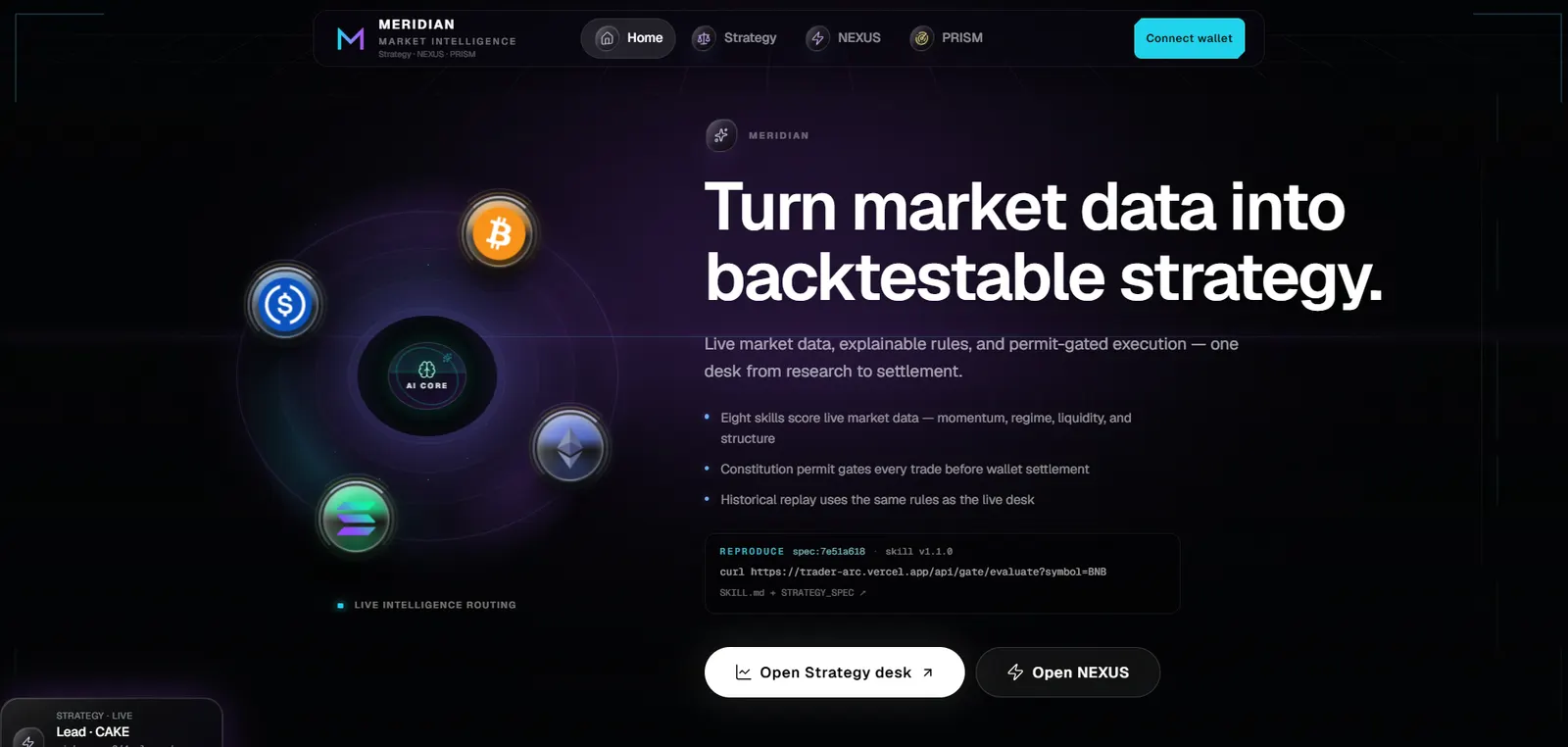
MERIDIAN market intelligence and strategy replay interface

Explainable market-strategy desk

MERIDIAN

A market-strategy desk where deterministic skills and a nine-check gate decide, a constitution permit allows or denies, and wallet-signed swaps execute on BSC Testnet.

Why it is relevantA dense, multi-stage interface — data, rules, analysis, replay — kept legible across the workflow.

  • Eight deterministic market skills
  • Nine-check gate and GRANT/DENY permit
  • Versioned replay against a baseline
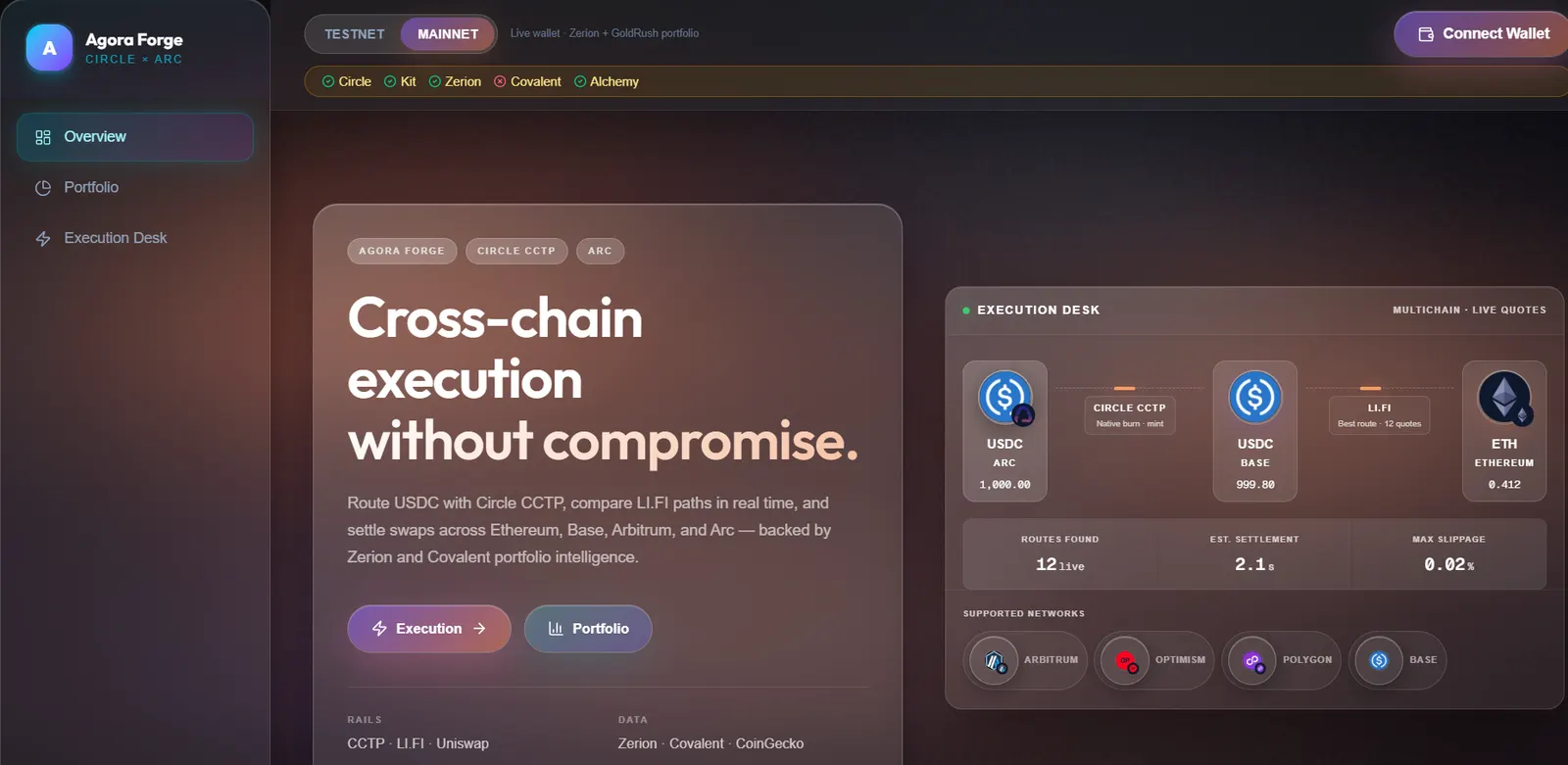
Agora Forge portfolio and cross-chain USDC execution interface

Cross-chain USDC portfolio workspace (testnet)

Agora Forge

A multichain portfolio and execution workspace: aggregated balances, deterministic rebalance logic, and wallet-approved USDC moves via Circle CCTP and LI.FI on testnets.

Why it is relevantSeparate portfolio, execute, and rule-based console surfaces with visible states between them.

  • Multichain portfolio aggregation
  • Circle CCTP via App Kit (testnet)
  • LI.FI route comparison
07Stack

Technical approach

Interface
  • React
  • Next.js
  • Accessible HTML

Responsive layouts verified on phone, tablet, and desktop sizes.

Logic
  • TypeScript
  • Server actions / route handlers

Validation and permissions enforced where users cannot bypass them.

Data
  • Postgres
  • REST APIs

Real records and external services behind explicit contracts.

Quality
  • Playwright
  • Preview deployments

Critical path and failure states tested in a real browser.

Projects commonly use TypeScript, Next.js, React, SQL-backed models, Supabase, Postgres, Prisma, REST APIs, webhooks, GitHub, and Vercel. The stack follows the workflow, security boundary, and maintenance need—not a generic checklist.

Remote delivery is structured for clients in the United States, United Kingdom, Canada, and other international markets: written scope, asynchronous progress, scheduled overlap, repository ownership, acceptance criteria, and a deployment handoff are made explicit.
08Questions

Questions about web application development

What is included beyond the frontend?

A web application engagement can include data models, authorization, APIs, integrations, validation, testing, deployment, and the loading and failure states users encounter.

Can you build dashboards and internal portals?

Yes. Dashboards, operational consoles, customer portals, and multi-step workflows are a strong fit when the important decisions and actions are clearly defined.

Will the application work on mobile?

Responsive behavior is planned around the workflow and verified across practical mobile, tablet, and desktop sizes.

Can you integrate an existing backend?

Yes. Existing APIs and services can be used after their contracts, authentication, error behavior, and ownership boundaries are reviewed.

PROJECT INQUIRY

Discuss your web application.

Share the goal, current state, constraints, and useful links. I’ll help identify the most useful path forward.