Skip to content
abdullah.

Service / AI Application & Agent Development

AI Application Development Services for controlled workflows.

Build AI applications and agent workflows that connect models to real data, scoped tools, review steps, and measurable product outcomes.

Engagement fit

Best fit for

  • Products adding AI to an existing user workflow
  • Teams connecting models to private data and external tools
  • Operations that need automation with reviewable decisions
01Controlled agent path

A controlled AI application workflow

Controlled agent path
  1. 01User requestArrives with account, role, permissions
  2. 02Scoped contextRetrieval and product state for this user only
  3. Model boundary03Model callBounded task, structured output
  4. 04Validate outputSchema, policy, and confidence checks✕ invalid: to 05 Fallback→ valid: to 06 Scoped tools
  5. 05FallbackInvalid or low-confidence → non-AI path or review queue
  6. Control06Scoped toolsLeast-privilege contracts and step limits◆ to 07 Human approval
  7. 07Human approvalBefore irreversible or sensitive actions◆ to 08 Recorded outcome
  8. 08Recorded outcomeResult, sources, and an audit trail⇢ reviewed: to 09 Evaluation set
  9. Operations sidecar09Evaluation setReviewed cases become regression tests
  10. 10TracesEvery model call and tool step logged
  11. 11Cost & step limitsBudgets, timeouts, maximum steps
  • Request path
  • Human decision
  • Fallback
  • Evaluation loop
  • Trust boundary

Models handle bounded reasoning while permissions, tools, evaluation, and irreversible actions remain explicit.

02Signals

Signs a workflow is ready for AI

  • A useful workflow needs model reasoning without giving up control or traceability.
  • An existing product needs an AI feature connected to its real data and permissions.
  • A repetitive research, support, or operations task needs tool use and human review.
03Autonomy

Automation, AI-assisted workflow, or agent?

Most products need less autonomy than a demo suggests. Pick the least autonomous option that does the job — the AI feature vs automation guide walks through the decision.
Deterministic automationAI-assisted workflowTool-using agent
Best forThe same input should always produce the same actionInterpreting or generating content inside a fixed flowMulti-step tasks where the next tool depends on what was found
Who decidesRules you wrote and testedThe model suggests; the product or a person confirmsThe model plans within the tools it is permitted to use
Primary controlTests and input validationStructured output, evaluation, and a fallback pathLeast-privilege tools, step limits, approval points, audit log
Main riskRigid when inputs varyPlausible but wrong outputWrong or excessive actions
Cost profileLowest and predictableA model call per taskSeveral model calls per task; the most variable

Start from the left; move right only when the task genuinely needs it.

04Failure and control

What can go wrong, and what controls it

Every AI feature has failure modes. The product design decides whether they stay contained.

RiskWhat it looks likeControl in the productWhere a person stays involved
Incorrect or invented outputA confident answer the data does not supportStructured output, validation, retrieval with sources, evaluation setReviews low-confidence or high-impact results
Prompt injectionRetrieved or user content tries to change instructionsTreat inputs as data, restrict tool scope, keep secrets out of contextApproves actions triggered from untrusted content
Over-permissioned toolsThe agent can do more than the task needsLeast-privilege tool contracts, allow-lists, step limitsAuthorizes irreversible actions
Sensitive data exposurePrivate records reach the model or the wrong userPer-user retrieval scope, redaction, explicit data boundariesOwns the data-access policy
Cost or latency spikesLoops, long contexts, or retries multiply callsBudgets, timeouts, caching, maximum stepsSets and reviews the limits
Provider outage or model changeThe API is down, or behavior shifts after an updateFallback path, pinned model versions, regression evaluationDecides when a new model is promoted

Controls are designed before release and verified with the evaluation set.

05Capabilities

What can be built

  1. 01

    AI-assisted web applications and product features

  2. 02

    Agent workflows with explicit tools, permissions, and approval points

  3. 03

    Retrieval and structured-data integrations

  4. 04

    Evaluation, fallback, observability, and cost controls

06Delivery

From scope to a working release

  1. 01Define

    Define the task, evidence, permissions, and human decision points

  2. 02Connect

    Connect models to controlled tools and structured product state

  3. 03Evaluate

    Evaluate useful and failure cases before monitored release

What you should have at handoff

  • An AI feature inside a complete product workflow
  • Clear fallback, review, and ownership boundaries
  • Observable behavior the team can test and improve
07Proof

Relevant work

Public builds with live products and source you can inspect. No private client metrics are claimed.

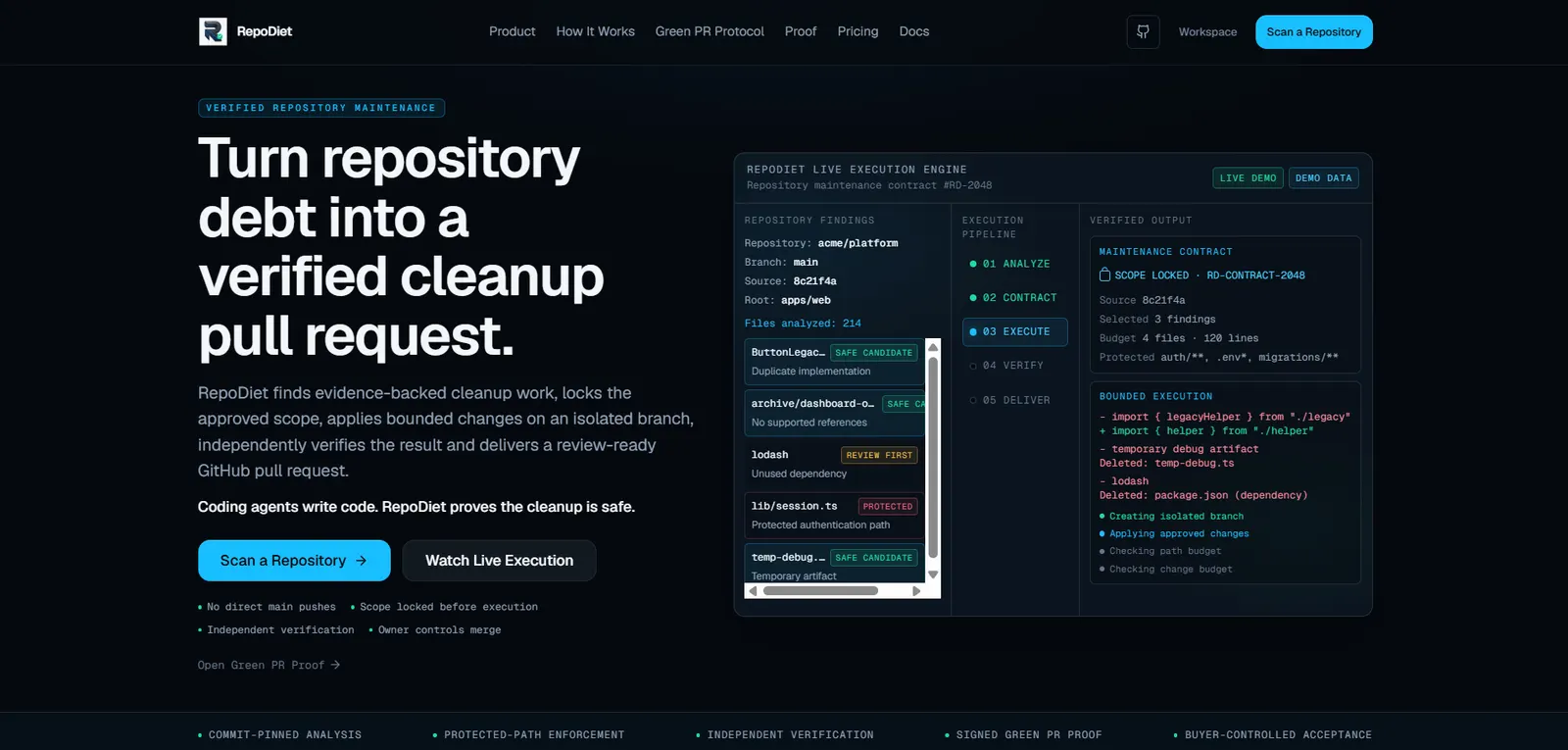
RepoDiet repository maintenance and verification interface

Contract-bound repository maintenance

RepoDiet

Repository maintenance for JS/TS codebases: evidence-gated triage, a signed change contract, bounded changes on an isolated branch, and a signed verification receipt.

Why it is relevantAutomated changes pass through a signed, scoped contract and a separate verifier role before a review-ready pull request exists.

  • Evidence-gated triage (Knip, jscpd, Madge)
  • Signed, commit-pinned change contracts
  • Separate verifier role and signing key
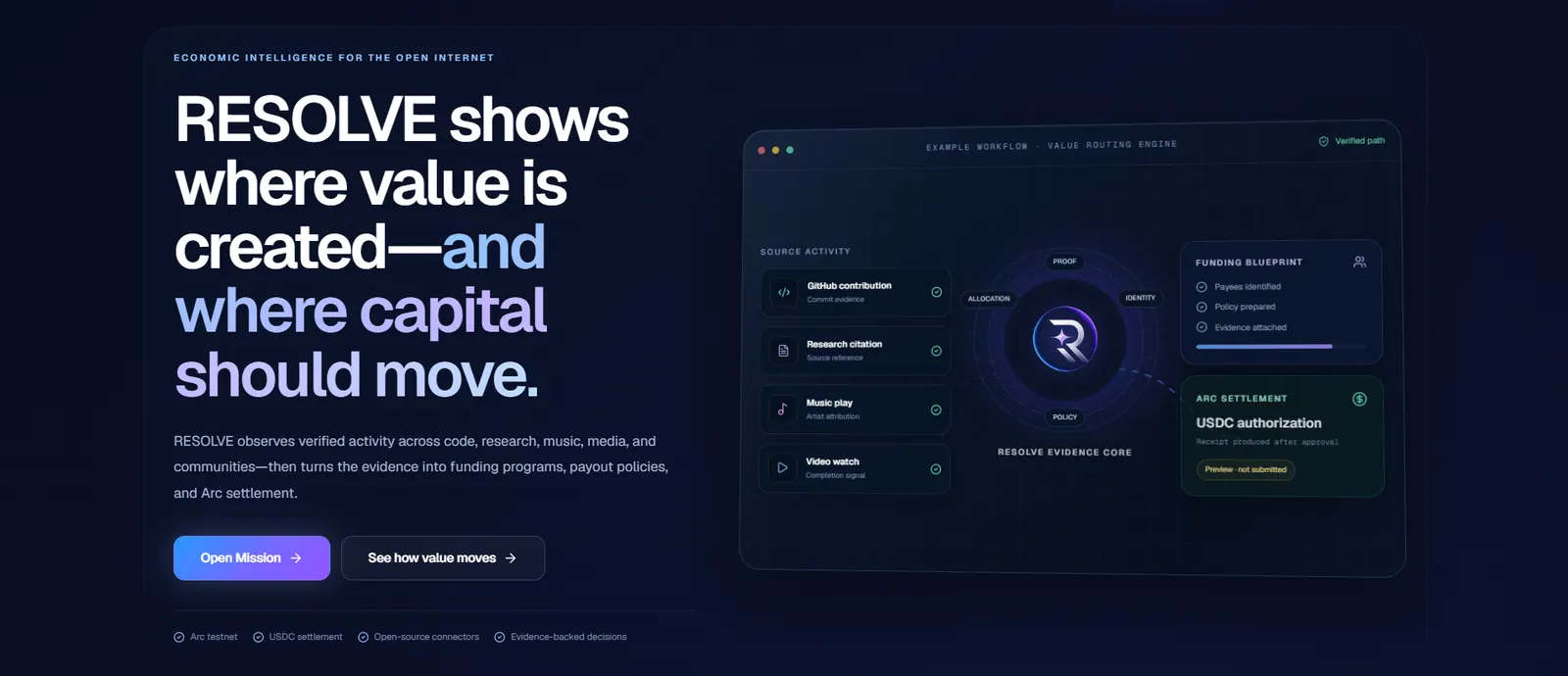
RESOLVE contribution evidence and funding workflow interface

Evidence-backed contribution funding

RESOLVE

A contribution-funding platform that turns verified evidence into policy-checked allocations, with USDC escrow settlement on Arc Testnet.

Why it is relevantModel-assisted features sit around deterministic funding and settlement logic; live payouts stay behind a feature flag and a review gate.

  • Evidence connectors and identity resolution
  • Versioned policy snapshots with lineage hashes
  • Quadratic funding in bigint micro-USDC
08Stack

Technical approach

Model layer
  • Model provider APIs with structured output
  • Prompt and tool definitions in version control

Behavior changes are reviewed like code.

Data & context
  • Retrieval over Postgres / Supabase records
  • Per-user scoping

Nothing reaches the model that the user could not see.

Tools & control
  • Explicit tool contracts
  • Approval steps

Least privilege; irreversible actions stay gated.

Quality & operations
  • Evaluation sets
  • Tracing
  • Cost limits
  • Non-AI fallback

Observable behavior the team can test and improve.

Projects commonly use TypeScript, Next.js, React, SQL-backed models, Supabase, Postgres, Prisma, REST APIs, webhooks, GitHub, and Vercel. The stack follows the workflow, security boundary, and maintenance need—not a generic checklist.

Remote delivery is structured for clients in the United States, United Kingdom, Canada, and other international markets: written scope, asynchronous progress, scheduled overlap, repository ownership, acceptance criteria, and a deployment handoff are made explicit.
09Questions

Questions about AI applications and agents

When should a workflow use an AI agent?

Use an agent when the task benefits from model reasoning and controlled tool use. Deterministic rules are usually better for fixed calculations, permissions, and irreversible actions.

Can AI connect to our existing data and tools?

Yes, through scoped retrieval, APIs, and explicit tool contracts, with permissions and sensitive-data boundaries designed before release.

How do you reduce incorrect AI output?

Use structured inputs and outputs, retrieval where appropriate, validation, constrained tools, test sets, human review, and fallbacks rather than relying on one prompt.

Can an AI feature be added to an existing product?

Yes. It can be introduced as a defined workflow with observable behavior, cost controls, and a non-AI fallback where the product requires one.

PROJECT INQUIRY

Discuss your AI application or agent workflow.

Share the goal, current state, constraints, and useful links. I’ll help identify the most useful path forward.