Skip to content
abdullah.

Service / Product Rescue & Stabilization

Product Rescue for software that needs a reliable path forward.

Diagnose a stalled, fragile, or AI-built product, stabilize the critical workflow, and leave the codebase easier to operate and extend.

Symptoms we start from

Best fit for

  • Founders with a promising prototype that is not release-safe
  • Teams inheriting an unstable or poorly documented application
  • Products with recurring integration, data, or deployment failures
01Signals

Signs the product needs a rescue

  • A prototype works in a demo but fails under real use.
  • The team cannot confidently release because errors, ownership, or scope are unclear.
  • AI-assisted changes have accumulated faster than the codebase can be reviewed and trusted.
02Rescue pipeline

Stabilize before expanding

Rescue pipeline
  1. 01SymptomsReports, errors, failed demos
  2. 02ReproduceEnvironment, input, expected result
  3. 03DiagnoseCode, config, integration, or product gap
  4. 04ContainStop data damage; feature-flag or roll back
  5. 05StabilizeNarrow release path first
  6. 06VerifyAcceptance checks on the release build↺ fails check: back to 05 Stabilize
  7. 07ReleaseKnown limits, rollback path, monitoring⇢ to 08 Recovery plan
  8. 08Recovery planRanked, evidence-backed next scope
  • Rescue sequence
  • Back to stabilization
  • Feeds the plan

Rescue work follows evidence from the critical workflow instead of beginning with an unbounded rewrite.

03Triage

From everything reported to what gets fixed first

Most rescue backlogs are too long to act on. Triage narrows them with evidence.

  1. 01Everything reportedBugs, complaints, TODOs, “it feels slow”

    Logged, not yet trusted

  2. 02ReproducibleExact input, environment, and result recorded

    Unreproducible reports wait for evidence

  3. 03On the critical pathBlocks the one workflow that must work

    Off-path issues go to the recovery plan

  4. 04Fix nowData, auth, integration, or release blockers

Nothing is dropped: work outside the funnel moves to the ranked recovery plan.

04Risk

Where fragile products usually break

Typical starting placement; every rescue re-ranks from reproduced evidence. The AI-built app rescue guide covers the method step by step.
  1. Authorization gapsImpact high · likelihood medium

    Check every server route and data query against the user’s role, not only the hidden button.

  2. Data integrityImpact high · likelihood medium

    Constraints, migrations with a rollback, and a backup verified by restore.

  3. Broken integrationsImpact medium · likelihood high

    Reproduce against the provider sandbox; add retries, idempotency, and visible failure states.

  4. Unrepeatable deploysImpact medium · likelihood high

    One documented release path with environment variables listed and a rollback.

  5. Silent errorsImpact medium · likelihood high

    Error tracking and logs on the critical path before anything else changes.

  6. Slow screensImpact low · likelihood medium

    Measure first; fix the queries and payloads the critical path actually uses.

  7. Visual polishImpact low · likelihood low

    Deferred until the workflow is dependable.

05Capabilities

What can be built

  1. 01

    Critical-path product and codebase assessment

  2. 02

    Reproducible defect and risk inventory

  3. 03

    Focused fixes for reliability, data, integrations, and release flow

  4. 04

    Verification evidence, deployment notes, and a prioritized recovery plan

06Delivery

From scope to a working release

  1. 01Reproduce

    Reproduce the critical workflow and rank failures by user and business impact

  2. 02Stabilize

    Stabilize the narrowest release path before expanding scope

  3. 03Verify

    Verify behavior, document ownership, and hand over a sequenced recovery plan

What you should have at handoff

  • A dependable critical path with known limitations
  • A smaller, evidence-backed backlog instead of an unbounded rewrite
  • Clear release, monitoring, and code ownership boundaries
07Proof

Relevant work

Public builds with live products and source you can inspect. No private client metrics are claimed.

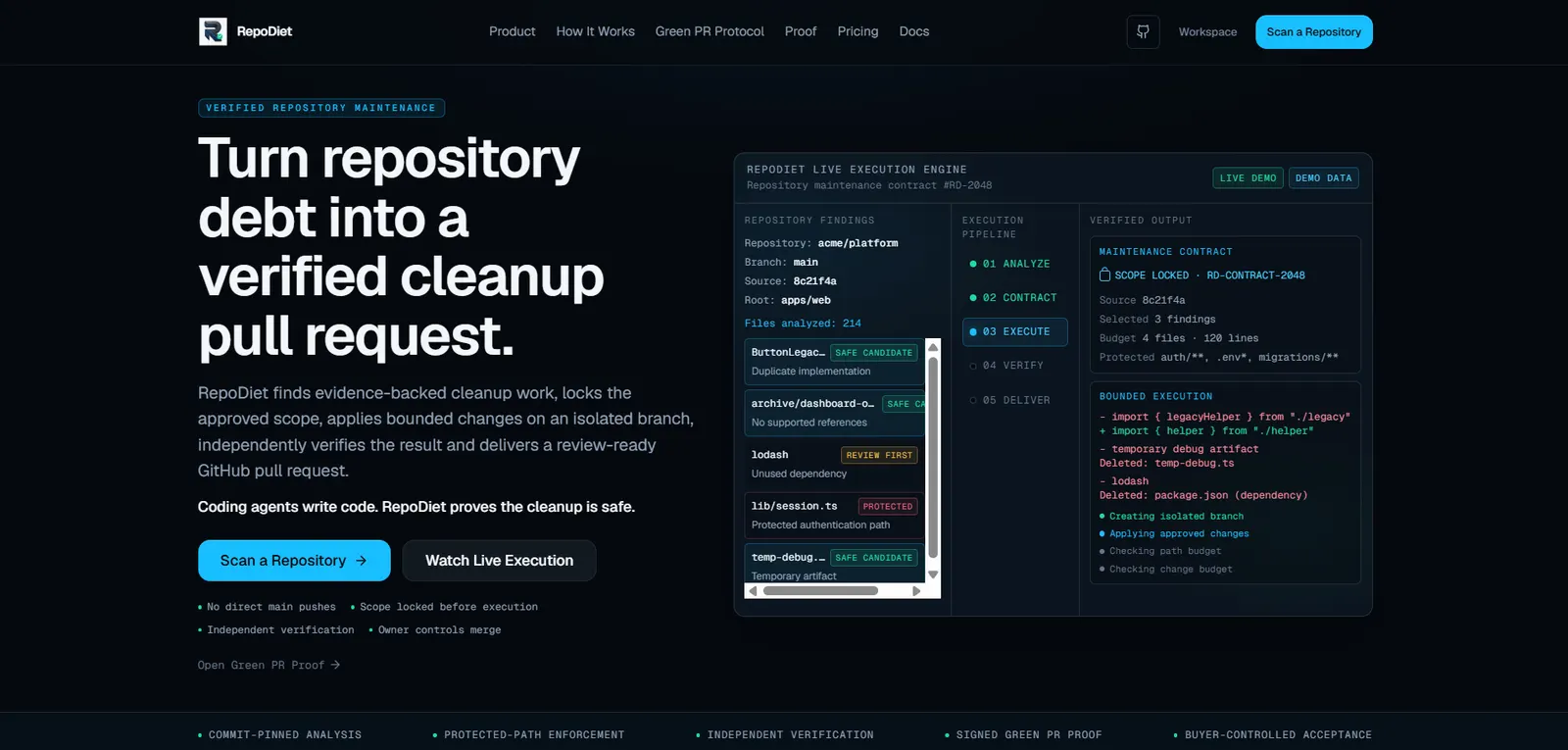
RepoDiet repository maintenance and verification interface

Contract-bound repository maintenance

RepoDiet

Repository maintenance for JS/TS codebases: evidence-gated triage, a signed change contract, bounded changes on an isolated branch, and a signed verification receipt.

Why it is relevantBuilt for AI-assisted codebases: evidence-gated triage, contract-scoped cleanup, a separate verifier role, and signed receipts.

  • Evidence-gated triage (Knip, jscpd, Madge)
  • Signed, commit-pinned change contracts
  • Separate verifier role and signing key
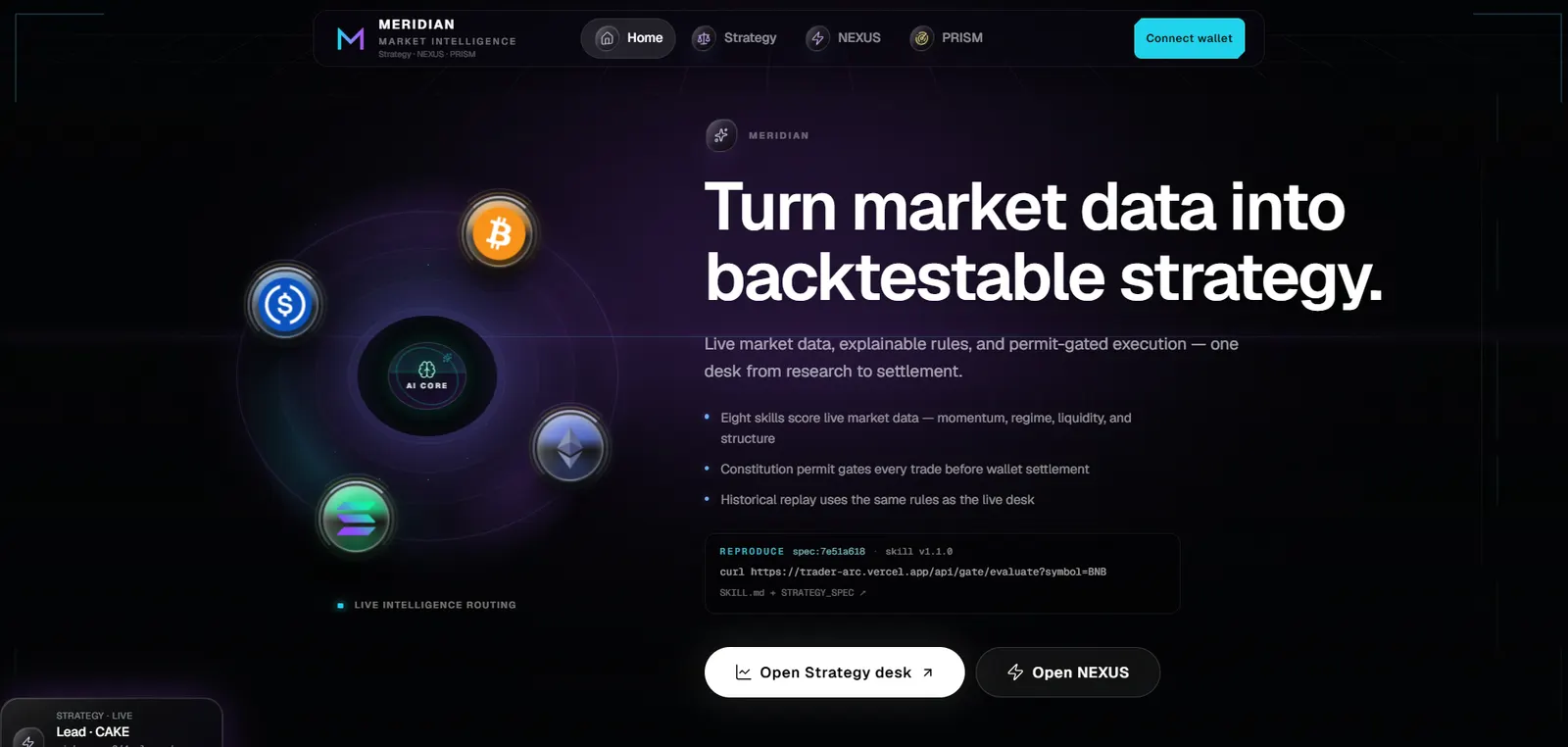
MERIDIAN market intelligence and strategy replay interface

Explainable market-strategy desk

MERIDIAN

A market-strategy desk where deterministic skills and a nine-check gate decide, a constitution permit allows or denies, and wallet-signed swaps execute on BSC Testnet.

Why it is relevantDeterministic skills and replay make behavior reproducible — the same property rescue work depends on.

  • Eight deterministic market skills
  • Nine-check gate and GRANT/DENY permit
  • Versioned replay against a baseline
08Stack

Technical approach

Observe
  • Error tracking
  • Structured logs

See failures before changing code.

Prove
  • Playwright
  • Reproduction scripts

A failing check first, then the fix that turns it green.

Protect
  • Constraints
  • Migrations
  • Backups

Data integrity before features.

Release
  • Preview deployments
  • Rollback path

Every release reversible and documented.

Projects commonly use TypeScript, Next.js, React, SQL-backed models, Supabase, Postgres, Prisma, REST APIs, webhooks, GitHub, and Vercel. The stack follows the workflow, security boundary, and maintenance need—not a generic checklist.

Remote delivery is structured for clients in the United States, United Kingdom, Canada, and other international markets: written scope, asynchronous progress, scheduled overlap, repository ownership, acceptance criteria, and a deployment handoff are made explicit.
09Questions

Questions about product rescue

Do you recommend a rewrite?

Only when evidence shows the current system cannot support the required workflow safely or economically. Most rescue work should first isolate the critical path, reproduce failures, and compare focused repair with replacement.

Can you work on an AI-generated codebase?

Yes. The code is treated as untrusted until contracts, tests, security boundaries, data behavior, and release steps are verified against the product workflow.

What happens during the first assessment?

The assessment maps the release path, reproduces high-impact failures, reviews ownership and deployment, and produces a ranked plan with explicit assumptions and stop conditions.

Can you fix a vibe-coded app built with Lovable, Bolt, v0, Cursor, or Replit?

Yes. An app generated with an AI builder is treated like any inherited codebase: reproduce the critical workflow, then check authentication, authorization, secrets, data integrity, and the deployment path before stabilizing the narrowest release. Rebuilding is only recommended when the evidence shows the existing path cannot be made dependable.

Can rescue work be delivered in phases?

Yes. A common sequence is assessment, critical-path stabilization, integration and data repair, release verification, then maintainability improvements that are justified by observed risk.

PROJECT INQUIRY

Discuss the product that needs stabilizing.

Share the goal, current state, constraints, and useful links. I’ll help identify the most useful path forward.